

Farmers partner with ag tech startups, gaining equity while helping test and scale new agricultural innovations.
By: Forrest Laws, February 18, 2026, Delta Farm Press, Farm Progress
It may have been one of the most diverse farmer panels ever: a vegetable farmer from Arkansas; a corn, soybean and wheat grower from Tennessee; a produce farmer also from Tennessee; a grain producer and merchandiser from Iowa; and a seed and vegetable grower from Oregon.
They were participants in the panel discussion “AgLaunch Farmers: Selecting, Testing and Scaling New Ideas,” which was held during the AgLaunch 2026 event in Memphis, Tenn., in late January. A sixth panelist — a farmer from North Dakota — was unable to attend due to weather.
The event ran the gamut from a North Carolina State University professor talking about a new farmer-centered Plant Science Initiative to three startup founders and executives who have raised more than $2.5 billion in venture capital for their ag tech companies.
But much of the focus was on farmers. “Over 20 years ago, when I was working with my first couple of startups, I said what I still believe today,” said AgLaunch President Pete Nelson, “Farmers must be in the middle of building new technologies, farming systems and alternative crops in a meaningful way.”
Equity positions
For AgLaunch, that means farmers who collaborate with new startups earn equity positions in the ventures in exchange for providing their time, land and farming expertise in helping the founders conduct trials.
“Getting equity in the companies is just unheard of,” said Helle Ruddenklau, a grass seed and vegetable producer from Amity, Ore. “We do a lot of work for those companies when they come out on the farm. We help them, which is worth something. The AgLaunch model recognizes that, and I appreciate it.”
“After I graduated from the university, I worked four years for the Extension service as a research assistant. I did a lot of field trials, so I have a background in that,” Ruddenklau said. “On the farm, we were also bringing researchers out and doing trials with them” on crops of grass seed, sweet corn, green beans and hazelnuts.
When AgLaunch expanded to Oregon, “it was a completely different setup than anything I had heard about before,” she said. “Here was a way to do farm trials, yet get equity in the companies we were working with. So we jumped at the opportunity.”
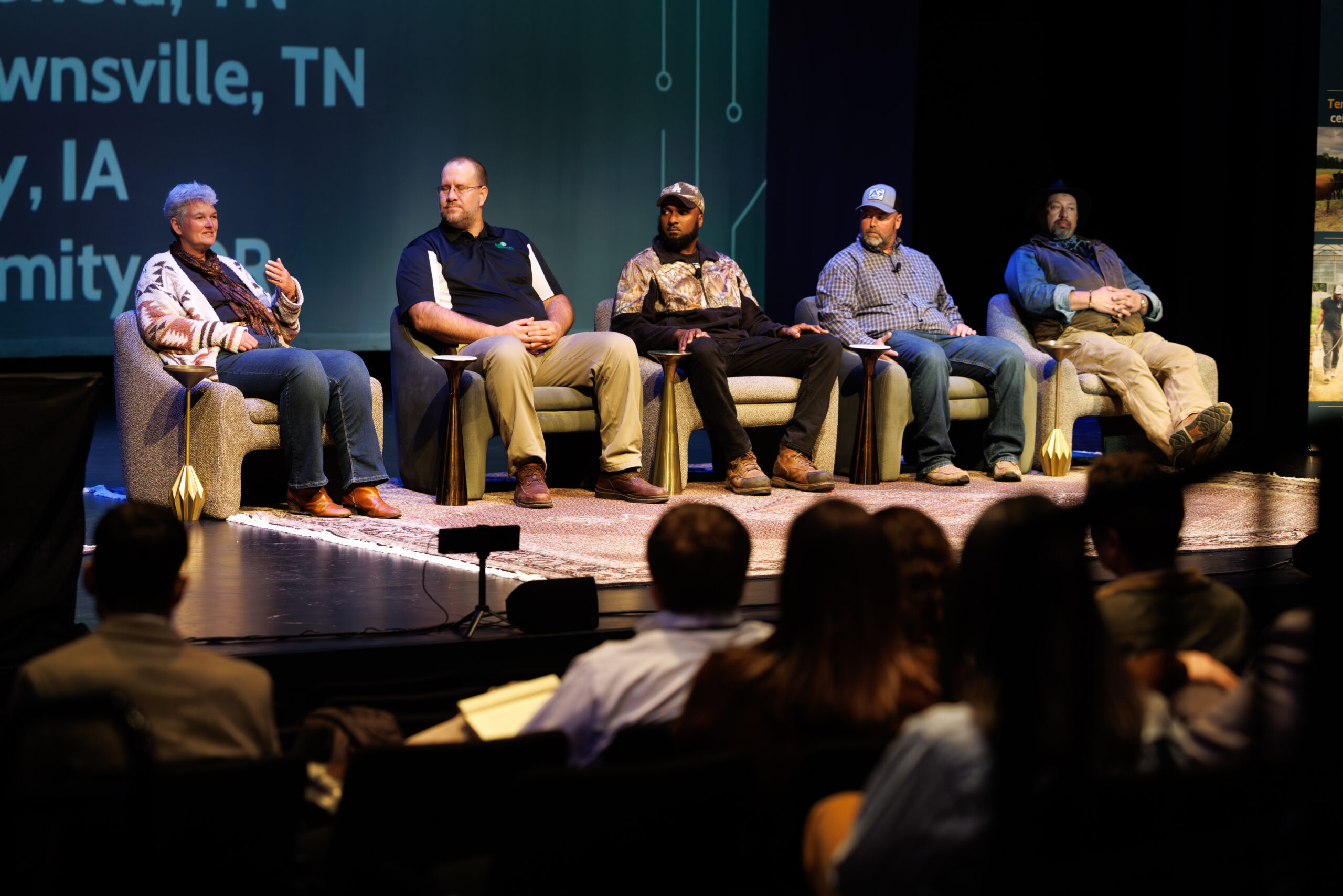
STARTUP EXPERIENCE: Shawn Peebles (right) of Arkansas talks about his involvement with tech startups during a panel discussion at AgLaunch 2026. Joining him are Helle Ruddenklau of Oregan (left), Joe Rowe of Iowa, and Matthew Robinson and Grant Norwood, both of Tennessee.
It usually doesn’t take long for farmers to get immersed in the new projects, said Shawn Peebles, an organic vegetable farmer from Augusta, Ark. “Early on, we were supposed to meet with the founder of the startup we were working with for 15 minutes, [and] an hour-and-a-half later, we’re still discussing plans for how to work with their product.
“I’m involved in AgLaunch because innovation is agriculture. Agriculture is changing at a fast pace now, and technology will probably be the driving force for most of us to survive in this industry,” said Peebles, who grows 2,000 acres of sweet potatoes, pharmaceutical pumpkins and other crops for food processors.
Grant Norwood, a fifth-generation corn, soybean and wheat farmer from Mansfield, Tenn., was one of the first farmers to get involved in field trials with startups selected for the AgLaunch cohorts.
“I love to get to see the innovation, to be the forward looker, and how to shape and mold the new companies that come through,” he said. “Ultimately, we want to build a better agriculture, improve our way of life and see it thrive.”
Desired technologies
The AgLaunch model works because, ultimately, farmers want new companies and their technologies to succeed, said Joe Rowe, who grows corn and soybeans on his farm near Mason City, Iowa.
“A founder can take a product to different laboratories or different contract places, and find ways to break their idea and product,” he said. “One of the differentiators here is that we’ll break your product, and we’re going to stand beside you and try to help build up the next version that won’t break — or have within the network the resources to find the industry skill sets to do the same.”
When starting college and thinking about careers, Rowe got this advice from his father: “Don’t start farming.
“He got out of farming in 1997 when a handshake was no longer valid, and a bank took over from his landlord,” Rowe said of his father. “Fast-forward to 2008, and I had the opportunity to start renting ground. and here I am today farming.
“I also work as a grain merchandiser, and I have the privilege now through my involvement with AgVentures Alliance to sit on its board,” he said. “Our CEO knew that I was doing trial work with some biological products, and he connected me with AgLaunch. The company I worked with, Organix, is doing great, and I still use their product.”
Matthew Robinson, owner-operator of the Produce Tribe, a specialty crop farm near Stanton, Tenn., also took an unconventional route to farming. He grew up in Nashville, Tenn., but reconnected to the family land in West Tennessee.
“I think initially the pitch from Pete [Nelson] just made a lot of sense to me, because I think hard work can’t be the only ingredient in farming,” Robinson said. “A lot of times we deploy our labor and hard work. I don’t really know any non-hardworking farmers. So the idea we can scale with equity in the company makes a lot of sense.
“Being in the room and on the selection committee and being privy to the information in the ag tech space helps you rewire your thought process in regard to agriculture and innovation so you can utilize the technology. I think the AgLaunch model where we pair the farmer with the startups is a win for all.
